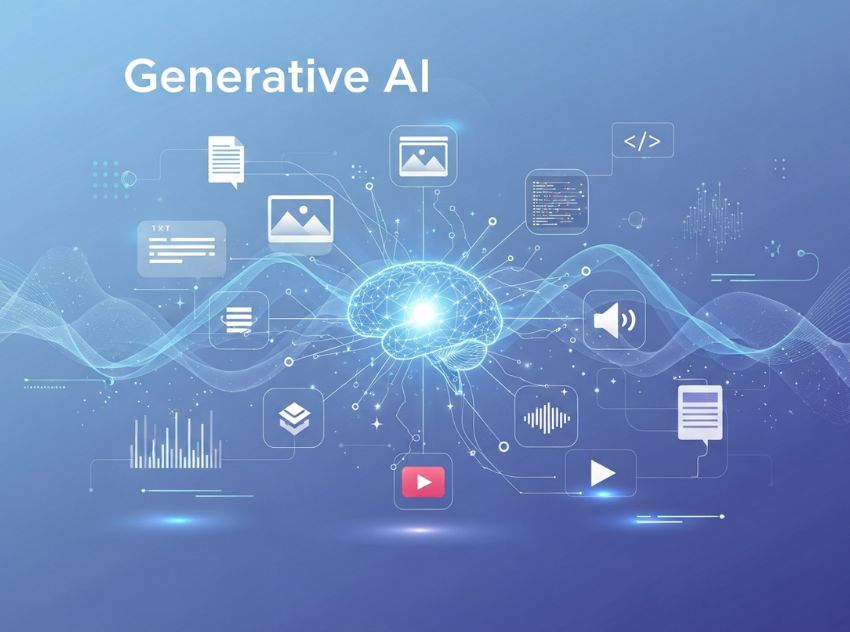
Nowadays, most businesses and professionals are facing the common challenge: creating high-quality content and providing innovative solutions. They have to do all of these tasks while maintaining their cost under control. However, traditional automation helps in some cases, but when it comes to creativity, complex problem solving, and language understanding, they don’t help. But Generative AI does as it helps users to create original images, codes, text, and more, similar to human intelligence.
Generative AI is the branch of AI that uses different large language models, machine learning algorithms, and creative foundation models to create advanced levels of content. Generative AI does all of these tasks from the vast datasets and based on the patterns.
So, what do you think Generative only helps in creating images or text? No, it does beyond it, and we will let you know all of it in this article with a little more detail related to generative AI.
What is Generative AI?
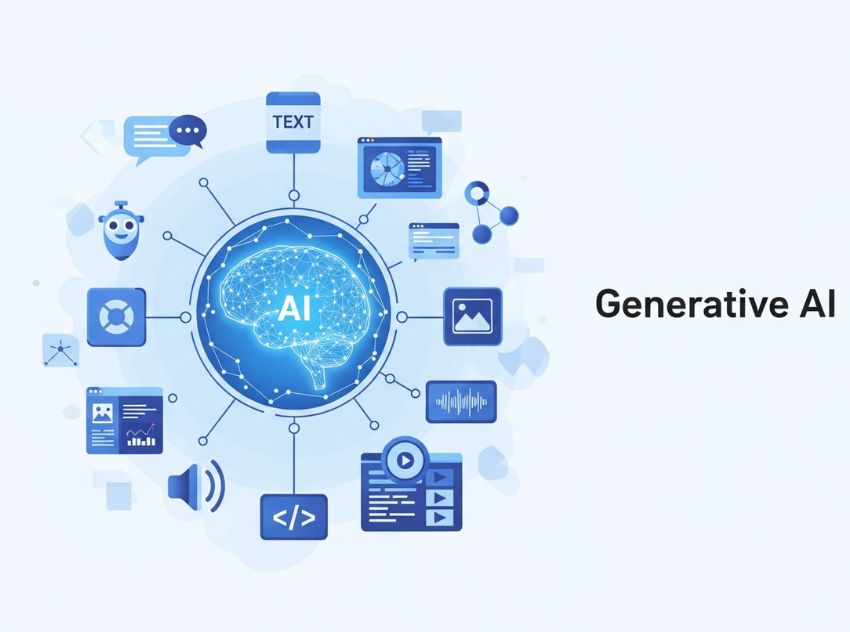
Generative AI is an AI model that not only analyzes data or fixed answers, but it is a modern AI system that creates something extraordinary. It includes text, images, music, videos, and code on learned patterns that are based on softwares.
The main function of Generative AI models is to understand how language, visuals, and logic work together by using machine learning algorithms and neural networks.
Generative AI applications and tools across different categories include:
Text & Conversational AI
- ChatGPT
- Google Gemini
- Claude AI
- Microsoft Copilot
- Jasper AI
- Copy.ai
Image Generation & Design
- Midjourney
- DALL·E
- Stable Diffusion
- Adobe Firefly
Video Generation & Editing
- Runway
- Synthesia
Audio & Voice Generation
- ElevenLabs
Code & Software Development
- GitHub Copilot
- Amazon CodeWhisperer
According to recent industry data, approximately 71% of organizations worldwide use generative AI in at least one business function. This stat shows how rapidly this technology has been adopted across sectors.
How does Generative AI work?
When it comes to the working of Generative AI, this AI model’s working includes a step-by-step process. That process allows the system to create new content. During the system training on large datasets, the neural networks learn patterns, relationships, and structures within the data, such as how words form sentences or how images are composed.
After that, technologies such as large language models and transformers help Generative AI to understand or analyze the context instead of isolated data points. For example, if a user gives a prompt about “create an image by providing text,” it analyzes the prompt by using patterns and then predicts the next output based on the possibilities. This overall process is known as inference, and it will still continue until the complete response is generated.
What Can Generative AI Create?
Now that we understand Generative AI and how it works, it’s time to explain what this model can create and how it works separately.
Text: It predicts words and sentences based on the context from LLMs and then generates articles, chatbot responses, and emails.
Images: The model creates attractive and compelling visuals, art, and designs.
Audio: Generative AI transforms speech to audio outputs and produces music and voice synthesis.
Video: Can easily create short clips or animations by analyzing the sequence and structure of images.
What are the Key Features of Generative AI?
- Content Generation at Scale: It produces different types of content efficiently at large volumes.
- Context Awareness: The model uses machine learning techniques to understand input context and provide customized output.
- Multimodal Capabilities: Generative AI has several capabilities, including images, audio, and text, and combines them in one output.
- Adaptability and Learning: It continuously adapts according to the user’s perspective and feedback.
Use Cases of Generative AI
The use cases of Generative AI include a marketing department where the model helps content creators by generating images and social media posts. In software development, the model helps with code generation, which accelerates the project.
It provides benefits to customer support through AI-powered chatbots, which provide instant and personalized responses. It helps the Finance and Forecasting field by using market analysis and predictive modeling.
Furthermore, many other modern platforms act as the AI tools for beginners that offer simple and easy user interference and outputs for non-technical background users.
Agentic AI Vs AI Agents Vs Generative AI: A Comparative Difference
| Agentic AI | AI Agents | Generative AI |
| Agentic AI gets input from users and then plans, creates goals, and takes action itself. | These systems perform different tasks by following rules, goals, and workflows. | A type of Artificial Intelligence that creates new content such as images, text, and more. |
What are the Benefits of Generative AI?
In this section, we will explain the key and major benefits of Generative AI that helps you to know more about this technology.
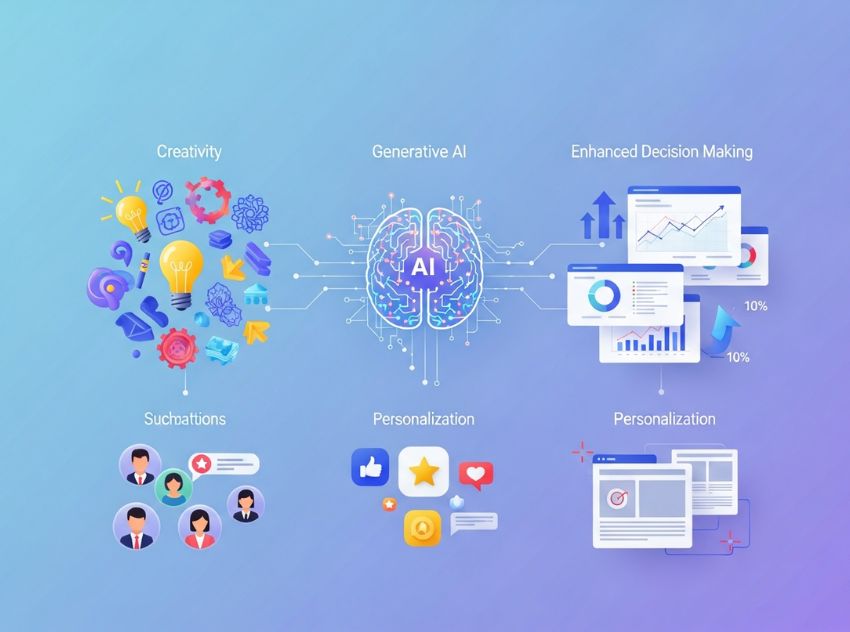
Enhanced Creativity
Generative AI provides fresh visuals, supports idea generation, design, and storytelling.
Improved and Faster Decision-Making
It generates insights and summarizes large datasets to help users analyze every situation quickly and inform decisions effectively.
Dynamic Personalization
The model provides personalized marketing solutions, customized recommendations, and improves customer experience.
The growing usage of Generative highlights its benefits, its role in AI in business automation, and helps companies to streamline their workflows and save operational costs.
Challenges and Limitations of Generative AI
When we explain the benefits of this model, it’s obvious that there are some challenges as well. Let’s look into it.
Sometimes, the model provides inaccurate facts and outputs because it predicts the response of customers based on possibilities instead of verifying or understanding.
You cannot always trust the audit results of AI models, and don’t make decisions based on them because they are sometimes unreliable.
Lastly, the security threat, including data leakage, deepfakes, misinformation, and more, is one of the most common challenges that we face with each AI models.
Conclusion
To sum up the overall article, Generative AI is the type of Artificial Intelligence that is trained on large datasets and helps users by generating text, images, code, and more. Many fields and departments are using this technology to accelerate their project and minimize their operational cost. Lastly, you have to consider the limitations and challenges of this technology as well and try to mitigate them as much as you can to maintain credibility.
To know more about AI technologies, explore XpertGuider, where we discuss emerging AI technologies that help businesses make smarter decisions.
FAQS
Is generative AI safe to use for small businesses?
You can use this technology for startups and small businesses under human supervision and with trusted tools.
Does generative AI require programming knowledge to use?
No, the majority of the generative AI tools are created for non-technical users and they work through basic prompts and visual inputs.
How is generative AI different from automation tools?
It is different from automation tools because it follows the fixed rules. On the other hand, Generative AI creates output based on user input, context, and learning patterns.