To begin with, I want to be honest. A lot of content fails. This isn’t said because the information is incorrect, but instead, it only speaks to one kind of person, in one kind of circumstance, with one kind of background. That is not how the world actually functions.
A teacher knowledgeable about photosynthesis talking to a room full of teenagers isn’t talking to one person. A marketing manager does not write for one customer when writing about a product launch. A tech blogger explaining cloud storage is definitely not writing for one type of reader. So why do most of us still create content as if we are?
That is exactly the gap that Your Topics Multiple Stories fills.
What This Approach Is Really About
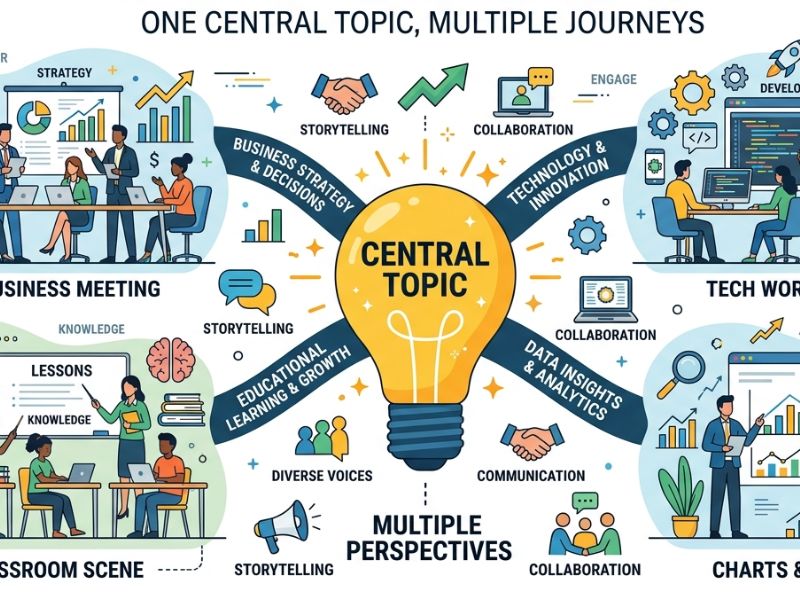
It means something quite simple. You select a topic and shift through various angles. You create variety not because you have more to say, but because your audience has different needs. Certain individuals require practical examples to comprehend the theory effectively. Others want the data first. Some connect through personal stories. Others just want the steps.
When you build content that includes all of these, something shifts. Stop skimming, start reading! Message us! They begin remembering, instead of forgetting.
Why This Guide Exists
This one is for teachers who would rather that their students understand, instead of just passing the exam. This is for business professionals who are sick of sending content into the void and getting nothing back. If you work in technology, you know that explaining difficult concepts to non-technical people is one of the hardest things to do well.
We are going to do everything practically on the project. This outlines the effectiveness of a strategy, the methods behind constructing it, and a proper final output.
Understanding Multi-Story Content
One Topic, Many Doors
Here is an approximation that might help you. Visualize a structure that has just one entry. People using the same door come from the north and south; they are carrying bags or walking freely; in a hurry or slowly. Some people make it in easily. Others struggle. A few give up and leave.
Visualize a single building that has 4 different entryways which are not only designed for varying types of individuals but also face all four cardinal directions. Getting on board without notice.
Your Topics Multiple Stories is about building those extra doors into your content.
How It Is Different From Regular Content
Regular content picks one angle and goes deep on it. That is not necessarily bad. But it does leave a lot of people behind. A blog post that explains a business concept purely through theory will lose the reader who thinks in examples. An article that only uses case studies will lose the reader who wants to understand the underlying principle.
A multi-perspective content strategy sits in the middle and serves both. It gives the theory and the example. The personal story and the data. The beginner explanation and the advanced application.
Why People Actually Remember It
There is a reason good teachers have always used stories. It is not a trick. The human brain is genuinely wired to hold onto information better when it is connected to narrative. When something is abstract, it floats. When it is anchored in a story, it sticks. Multiple stories on the same topic create multiple anchors. That is why this approach works not just for engagement but for actual retention and understanding.
Importance in Education
What Is Really Happening in Most Classrooms
Walk into most classrooms and you will see one explanation being given to thirty different minds. The teacher explains it clearly. A few students get it right away. Some are still processing. A few are already lost. And the lesson moves on.
This is not a failure of teaching effort. It is a failure of approach. One story cannot reach thirty different learners at once.
How Multiple Narratives Change Learning
Narrative-based learning and communication is the idea that when you wrap information in story and context, it moves from short-term to long-term memory more reliably. This is backed by decades of cognitive research, but you do not need the research to feel it. You already know it from your own life. You remember the teacher who told stories. You have forgotten most of the ones who only read from slides.
When an educator uses Your Topics Multiple Stories, they are not adding extra work for students. They are adding extra pathways for understanding.
Practical Example: Teaching Supply and Demand
Supply and demand is a simple economics concept. According to textbooks, the definition is just a starting point. Now imagine building four short narratives around that same concept.
The opening one is about a farmer that grew too many tomatoes during the summer and could not give them away. An explanation follows to discuss sanitizer prices that increased in early 2020. The third walks through what concert ticket scalping actually tells us about demand curves. The fourth is a simple chart showing how the relationship works visually.
Same concept. Four completely different ways in. Every student in the room finds at least one of them familiar.
Case Studies and Expert Commentary in Education
One of the most underused tools in education is the case study. Not because teachers do not know about them, but because building a good case study takes time. But at least there is a payoff. When students read about a real person who faced the real version of the problem that is being studied, the material is no longer something to memorize, but something to connect to and relate with.
Expert commentary works the same way. When a scientist describes, in their own words, why they were driven to obsess over a problem, it does something to a student that a quotation never does. It makes the subject feel alive.
For educators looking for more content strategies and teaching resources, the Education section on XpertGuider has a lot worth exploring.
Applications in Business
Why So Much Business Content Gets Ignored
Here is something most business communicators do not want to hear. It is unlikely that your report didn’t get read, your email didn’t get a reply and your presentation didn’t change anything because people were simply too busy. The content probably failed to spark an emotional response or urge to do something.
Business content that tells one story, in one voice, to one imagined audience, leaves most of the actual audience cold. The manager and the frontline employee need different angles on the same message. The investor and the customer are interested in different aspects of the same product. A single narrative cannot do all of that.
Product Launches That Actually Land
Think about what a product launch really needs to communicate. The customer needs to know what problem it solves for them personally. The press needs a story worth writing about. The internal team needs to understand the vision behind it. Partners need to know how it fits into the bigger picture.
One press release does not cover all of that. A multi-story launch does. You build a narrative for each audience without abandoning the core message. The product stays the same. The angle shifts depending on who is listening.
Internal Training That People Do Not Forget
Most training materials become obsolete after a while. People complete them out of obligation rather than their usefulness. Part of the reason is format. Bullet points and compliance checklists do not engage people the way stories do.
When training content uses a multi-perspective content strategy, it includes real scenarios where the skill matters. It demonstrates the differences between well implementation and poorly implementation of the model. Whether they are community members, end-users, or frontline workers, this includes the voices of people who have lived-through or experienced the situation.
People remember that kind of training because it feels real.
Marketing That Earns Trust
People are skeptical of brands. They have been advertised so much and so aggressively that their default response to most marketing is distrust. One of the most effective ways to break through that is to stop telling people what to think and start showing them enough different angles that they can reach their own conclusions.
Content storytelling can be a powerful tool to establish credibility through customer stories, honest comparisons, behind-the-scenes context, and underlining macros. One polished story can never do what this does. It demonstrates instead of narrating. That is the difference.
For more practical resources on business communication and strategy, visit the Business section on XpertGuider.
Applications in Technology
The Accessibility Gap in Tech Content
The audience has always been a problem for tech content. Those who understand it deeply, tend to write in a manner that only people who already understand it deeply can read. As a result, much important and useful information remains locked away due to jargon and assumed knowledge.
Your Topics Multiple Stories is one of the most direct ways to close that gap without dumbing things down.
The Same Tech Topic, Written for Four Different People
Take something like two-factor authentication. For a security professional, the interesting angle is the technical implementation and the threat models it protects against. For an average person setting up a new account, the interesting angle is why it matters and how to do it without it becoming annoying. For a business owner, the interesting angle is the risk reduction and the liability protection it provides. For a new employee being onboarded, the interesting angle is the simple step-by-step setup guide.
Four people. One topic. Four completely different stories. And all four are legitimate.
When technology content is built this way, it stops excluding people and starts actually serving them.
Tutorials That Go Beyond the Steps
A tutorial is incomplete if it only explains the steps. You go step by step. When you reach step four, something goes wrong and you have no idea why or what to do. A good tutorial contains an explanation for every step. It indicates what you should anticipate if you do it correctly and what to notice if something is wrong. This provides you with context so that you know what you are actually doing and not just what buttons to click.
Narrative-based learning and communication applied to technical writing is the difference between documentation that helps and documentation that technically exists.
Reviews That Are Actually Useful
Most product reviews are just opinions. They tell you what one person thought after using something for a week. A multi-story review gives you the beginner’s experience and the power user’s deep dive. It includes the performance data alongside the lived experience. It compares the product to realistic alternatives. It tells you who this product is actually right for and who should probably look elsewhere.
That kind of review helps people make real decisions. It is useful in a way that a single opinion piece never is.
More technology content written with this kind of depth is available in the Technology section on XpertGuider.
Step-by-Step Multi-Story Framework
A Practical Way to Build This Kind of Content
A lot of people understand why multi-story content works but freeze when it comes to actually building it. Here is a simple process that removes the guesswork.
Step 1: Get Specific About Your Topic
Vague topics produce vague content. Do not start with “leadership” or “technology in education” or “marketing strategy.” Go narrower. Try “how a new manager handles their first tough conversation with the team” or “what happened when one school gave tablets without training the teachers” or “why a tiny brand’s email beat its paid ads”.
They give specificity at the same time different stories don’t overlap. A broad topic gives your narratives nowhere clear to stand. A specific one gives each story its own defined space.
Step 2: Map Out Your Different Angles
Once the topic is clear, ask yourself who else has a perspective on it. Who experienced this situation? Who has studied it? Who disagrees with the obvious interpretation? Who will offer an inside look?
In most cases, you can find three to five genuinely different angles for a well-chosen topic without much stress. The adverb genuinely is key here. Five takes of the same point of view are not what you want. You will need five points of view, each of which adds something the others do not.
Step 3: Decide What Order Makes Sense
How you organize your stories shapes how readers experience a topic. Begin with the easy-going narrative that requires the least background knowledge and connects to the most people immediately. Add complexity after that. Shift from the known to unknown, from uncomplicated to complex, from personal to analytical.
Make sure to use transitions that bring back the focus to the main theme. Always make sure your reader knows what this narrative is doing here and how it connects to everything else.
Step 4: Match the Format to Each Story
Not every story belongs in the same format. A data-driven narrative often works better as a visual than as a paragraph. A personal account is more effective in the first person with a specific name and a specific situation. A process needs numbered steps, not prose. A case study must have a clear before-and-after analysis.
Focus on each story on its own and give it the form that serves that story. This also adds visual variety to the overall piece, which keeps readers moving forward.
Examples Across Categories
Education Examples
STEM and Science Topics
A lesson on climate change told through one scientific explanation reaches some students. The same topic told through science, a story about a community losing its coastline, the economic cost data, and a practical discussion of what students can realistically do, reaches almost everyone in the room. Your Topics Multiple Stories applied to science education turns abstract environmental data into something students feel connected to.
History and Social Studies
Teaching the French Revolution through the political timeline is fine. Teaching it through the eyes of the king, the hunger of the peasant, the ideology of the revolutionary, and its aftermath for the common man is a different thing altogether. Every story brings something to the table that other stories lack. They create a visual image that instigates critical thought from students.
Career Guidance for Students
School counselors want their students to think about their futures and one success story is not enough. The student who went for a conventional university route & loves it. The one who went to trade school and is earning well doing something they enjoy. The one who started a small business at nineteen. The one who tried three different things before finding the right fit. Multiple stories make possibility feel real in a way that a single role model never does.
Business Examples
Startup and Entrepreneurship Content
A case study about a startup that grew quickly is interesting. Add the co-founder’s account of the two times they nearly ran out of money, the early employee’s description of the culture before it had a culture, the investor’s honest reasoning for betting on them early, and the first customer’s experience, and you have something people will share and talk about. That is content storytelling for business and technology done well.
Leadership Training
A training module on giving constructive feedback is most effective when it includes managers reflecting upon an unpleasant conversation, and what they learned from it. A team member describes what actually helpful feedback was like. Research on what makes feedback land. And a clear practical framework built from all of the above. Theory plus story plus data plus practice. Each layer adds something.
Technology Examples
AI Tools in the Workplace
Writing about business adoption works better when it includes the exec who had to justify the budget, the IT team who did the implementation and what surprised them, the frontline employees who use the tools daily and what changed for them, and the customers who noticed something different about their experience. Abstract technology becomes concrete when it lives inside real human situations.
Software Tutorials for Mixed Audiences
A tutorial for project management software that only covers the basics serves beginners but leaves everyone else looking elsewhere. Build it with a quick start section for first-time users, a feature walkthrough for people who have used similar tools, an advanced configuration guide for power users, and a troubleshooting section written from the perspective of the most common things that go wrong. One product. Four different readers. All of them served.
Challenges and Solutions
When Stories Start Sounding the Same
This happens more than people expect. You start out to write about three narratives but somewhere while writing the second one, you realize you are doing quite the same thing as the first one, only of different people. The data is still the same. The insight is the same. The only thing that changed is the wrapper.
The fix is to define what each story uniquely contributes before you write a single word of it. Write one sentence: what does this narrative add that none of the other narratives have? If you cannot answer that clearly, the story does not belong in the piece. Cut it and strengthen the ones that remain.
When the Piece Feels Scattered
Multiple stories can make a piece feel like it is going in several directions at once. Readers get confused about what the actual point is. They finish the article and cannot tell you what it was really about.
This usually comes down to transitions. Every story should have a clear bridge that leads back to the topic. Can be short or small for anything. At times just a sentence. Without this coherence, their reading feels as though they are just reading a series of disparate arguments rather than one with many dimensions.
When You Cannot Find the Right Format
Forcing every story into the same format weakens the ones that need something different. A personal account written as a bulleted list loses something important. Assimilating a data story hidden within a paragraph is less intuitive than a straightforward chart.
The alternative is to consider what every narrative fundamentally requires in order to communicate effectively and then provide that. Some stories need visuals. Some need a first-person voice. Some need structure and numbered steps. Treating all narratives as interchangeable is what makes multi-story content feel flat.
When the Content Gets Too Long
More stories can mean more content, and more content is not always better. A piece with eight thinly developed narratives is weaker than a piece with three fully developed ones. Three to five stories is usually the right number. Each one should be complete enough to feel real and useful on its own. If your story seems thin, you either need to develop it properly or cut it out altogether.
Best Practices
Give Every Story Its Own Visual Support
Visuals are not decoration. They are part of the story. A diagram makes a process narrative clearer. A photograph gives a personal account weight. A chart makes a data story immediately credible. Consider what each story needs visually and build that in from the outset not as an afterthought.
Keep Every Story Connected to the Core Topic
It may sound obvious but it’s easy to let a compelling story pull you off course. Any story which is interesting but does not add any meaning to the main subject doesn’t belong in the piece. Regardless of how much you enjoy it. The question that should always be asked is: does this story clarify the topic, make it more believable, or make it more meaningful? If the reply is no, trim it.
Balance Theory With Real Examples
Pieces that lean too far toward theory lose readers who think in examples. Pieces that lean too far toward examples lose readers who want to understand the principle behind them. The strongest multi-story content balances both. For every conceptual narrative, include a practical one. For every case study, connect the lesson back to the underlying idea.
Write the Way You Actually Talk
This is possibly the most essential item on the list. The major difference between human-sounding content and generated content is whether the sentences sound like something a person would say out loud. Alter the lengths of your sentences. Make it shorter for impact. When you need to create or reveal tension in the reader, a longer sentence can work. A run-on works well if used just the right amount. Choose words that will regularly come up in conversation.
Look at What Your Audience Responds To
Once published a multi-story, see what people really engage with. Which stories get referenced in comments or shares? Which sections prompt the most questions? Which parts seem to get skipped? Real audience behavior tells you things that no amount of planning before publication can. Use it to improve the next piece.
Conclusion
What This Really Comes Down To
Your Topics Multiple Stories is not a formula. It is not a checklist. It is a way of thinking about the people you are communicating with and taking seriously the fact that they are not all the same.
In education, it helps students build the kind of understanding that they can actually use, not just repeat on an exam. In business, it makes communication more honest, more persuasive, and more useful to the people receiving it. In technology, it takes ideas that are genuinely complex and makes them accessible without stripping out the substance.
The Part That Most People Skip
Many individuals hear this. They nod their heads. And then they go back to creating content in the exact same way. Not because they disagree. Just because starting something new feels uncertain.
This is a small point to start with. Choose a topic requiring writing within the next two weeks. Imagine three truly distinct individuals who could be reading it. What does each of them need from that topic? Write a short narrative for each one. See how it feels compared to your usual approach.
That is it. That is the beginning.
The stories are already inside the topics you work with every day. Every subject has multiple angles. Every audience has multiple needs. Your Topics Multiple Stories is just the practice of taking that seriously and building content that reflects it.
And when you do that well, something changes. People stop scrolling past. They stop forgetting. They start sharing. They start coming back. That is what good content actually does, and it starts with telling more than one story.