Let me be honest with you. When I first heard about Blooket, I thought it was just another quiz app that teachers use once and forget about. I was wrong. The blooket game is something else entirely. Students who normally dread review sessions are suddenly asking when the next game is. That says a lot.
This blog covers every game mode on Blooket, which ones are actually worth playing, and some real tips for getting the most out of it in 2026.
So What Is the Blooket Game Anyway?
Blooket is a game based learning platform where students answer questions inside different themed games. Each game mode comes with its own set of rules and rewards that helps make quiz time feel totally different from the rest.
Teachers set up the game using the blooket host feature. They pick a question set, choose a mode, and share a blooket code with their students. Everyone joins on their own device and the game kicks off. No delays. No confusion. Just straight into the action.
What makes it different from other quiz tools is that answering questions is only part of it. The game around those questions is what keeps students locked in from start to finish.
Starting a Blooket Play Session
A blooket play session starts with the teacher logging in and selecting a question set. After picking a game mode, the host screen shows a blooket code. Students access the Blooket website, enter that code, and they are in the lobby within seconds.
To be honest, it takes as little as two minutes. Even on days when the Wi-Fi is being difficult, it still comes together pretty fast.
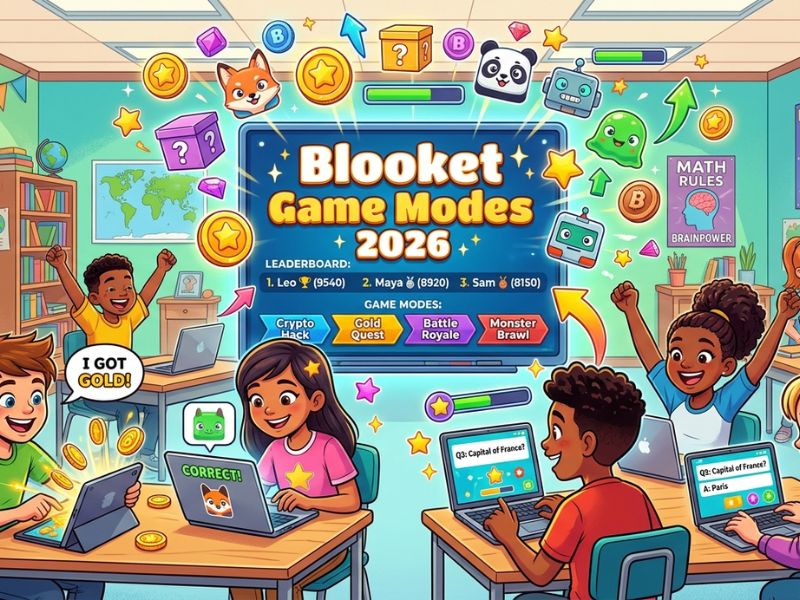
Breaking Down Every Blooket Game Mode
1. Gold Quest
Gold Quest is the mode most people try first and honestly it never gets old. You answer a question right and then a wheel spins. That wheel might double your gold. It might give you a small bonus. Or it might let you snatch gold straight from another player’s pocket.
I’ve seen students get taken over in the last minute, despite a full mark because of one bad spin. It is that unpredictability which makes it addictive. No one feels safe until the timer reaches zero.
Best for: General review, keeping energy up, any age group.
2. Tower of Doom
Tower of Doom puts students into two teams. Each team has a tower and the goal is to bring the other one down using attacks powered by correct answers. The more your team answers correctly, the more damage you deal.
Something shifts when students are playing for a team. They get louder. They start helping each other. They actually care about getting the answer right not just for points but because their teammates are counting on them. It’s one of the best blooket games for that reason alone.
Best for: Building teamwork, pre-test energy, group review.
3. Cafe
Cafe mode is a completely different vibe from the rest. In your restaurant, you earn money when answering correctly, purchase ingredients and serve customers. You are not being attacked. No one is robbing you. It’s simply you and your cute cafe.
Younger kids find this one really comforting. It moves at their pace and the restaurant theme keeps them interested without overwhelming them.
Best for: Younger students, relaxed review, low-energy days.
4. Factory
Factory mode gives you a production plant to manage. Answer questions to hire workers and produce books. The student with the highest production at the end wins. It’s calm, it’s individual, and it works really well when you want students focused without any chaos around them.
Best for: Individual practice, quiet classroom sessions, self-paced work.
5. Battle Royale
Battle Royale is not for the weak-hearted. Students playing to win and loss means elimination from the game in this quiz show. The winner is the last one remaining. Simple. Brutal. Incredibly effective at getting everyone to actually focus.
Students who usually coast through review sessions suddenly pay close attention because nobody wants to be eliminated first. There is a genuine pressure, and it has a significant impact.
Most Suitable For: Competitive Groups, Quick Reviews, High-Energy Classes.
6. Fishing Frenzy
Fishing Frenzy is easy-going and fun. Answer a question and you get to cast a line. Whatever fish you catch is worth a certain number of points. Some catches are big wins. Some are small. There’s a little luck involved which levels the playing field and stops the same student from dominating every single time.
Best for: Chill sessions, low-pressure practice, wrapping up a unit.
7. Crypto Hack
Crypto Hack is where the blooket game gets genuinely strategic. You answer questions to steal crypto from other players. Answer fast and you can take a big chunk. Slow down and someone might clean you out before you even realize it.
Older students especially love this one. It feels nothing like a school activity at all. It feels like a genuine competitive game, and having it attached to real learning content feels almost sneaky in the best way possible. Certainly one of the best blooket games for that age category.
Most Beneficial For: Middle school, high school, high achievers.
8. Monster Brawl
Monster Brawl is exactly what it sounds like. You fight monsters using your answers. Get a question right and your monster attacks. The monster designs are fun and the whole thing moves quickly enough to hold younger students’ attention throughout.
Best for: Elementary students, keeping younger kids engaged, visual learners.
9. Racing
Racing strips everything back to basics. Answer correctly and your blook moves forward. The first one across the finish line wins. No stealing. No luck. No random elements. Just whoever knows the material the best gets to the front fastest.
Students who genuinely prepare tend to dominate this mode and that’s kind of the point. It provides a more direct reward of actual knowledge than most.
Best for vocabulary drilling spelling practice timed review direct assessment
10. Blook Rush
Blook Rush is newer but it’s already become a go-to for short sessions. Players will collect blooks by answering questions with the player with the most blooks winning. The colorful quick activity can fit nicely within the first or last 5 minutes of a class.
Ideal for: Mobilizations, instant recaps, short intervals.
Figuring Out Which Mode to Use
No mode is best for all scenarios. It totally depends on your class and what you require on that day.
If the class is already buzzing with energy, Battle Royale or Crypto Hack can harness that power into something productive. If it’s a Monday morning and nobody is quite awake yet, Cafe or Fishing Frenzy will ease everyone in gently. For teamwork and collaboration, Tower of Doom is hard to beat. For pure individual performance, Racing shows you exactly who knows the content.
The flexibility of blooket play is genuinely one of its strongest points. You’re never stuck with one approach.
Real Tips for Blooket Hosts
Using blooket host well is about more than just pressing start. A few things that actually make a difference:
Share the blooket code before class even starts if you can. Send it in a message, write it on the board early, put it in your classroom management system. The less time wasted at the start, the more time you have for the actual game and the review after it.
Build your own question sets. Random sets from the library are fine but nothing beats a set that matches exactly what your students studied this week. The importance of the game causes the game to feel more relevant to what they’re learning.
Finish up with a debrief. As the blooket game is over, skim through the questions which people got wrong the most. That five minutes conversation at the end is where a lot of the real learning sticks.
Why Blooket Is Still Going Strong in 2026
A lot of edtech tools come and go. Blooket has stuck around because it solves a real problem. Students are disengaged. Worksheets don’t work. Students are wasting their time as they listen to lectures they have heard before. However, when the same content is placed inside a game and people compete, strategize and laugh, then it all goes in without even thinking.
In 2026, Blooket added better analytics for teachers, more solo practice features for students, fresh game modes, and an expanded blook collection that students genuinely get excited about collecting. It has extended far beyond the classroom to become something students use at other times too.
Conclusion
The blooket game has the ability to work because it understands that students, like everyone else, are human beings who like to have fun. It doesn’t attempt to mask lessons as something else with colors as these look like worksheets. It actually builds real games around real content and trusts that students will engage if the experience is worth engaging with. Whether you’re a teacher using blooket host to run a class session or a student joining with a blooket code from your bedroom, the experience is worth it. Try the best blooket games, mess around with different modes, and find what clicks for your group. Learning this enjoyment doesn’t come around very often.
FAQs
Q1: What is the blooket game?
It’s an online platform where students play themed games built around answering quiz questions. Teachers use it for classroom review and students use it for solo practice too.
Q2: How does blooket play work?
The host starts a game and shares a code. Students log into the Blooket website and enter that code so they can join that game utilizing their own devices. All players play together at once.
Q3: What is a blooket code?
It’s the join code the host gets when they start a game. Students need it to enter the session.
Q4: Which are the best blooket games for competitive students?
Crypto Hack and Battle Royale are the best blooket games for students who want real competition and fast gameplay.
Q5: Is blooket host free to use?
Yes, the core hosting features are free. There’s a paid plan with extra tools but you can run solid sessions without spending anything.